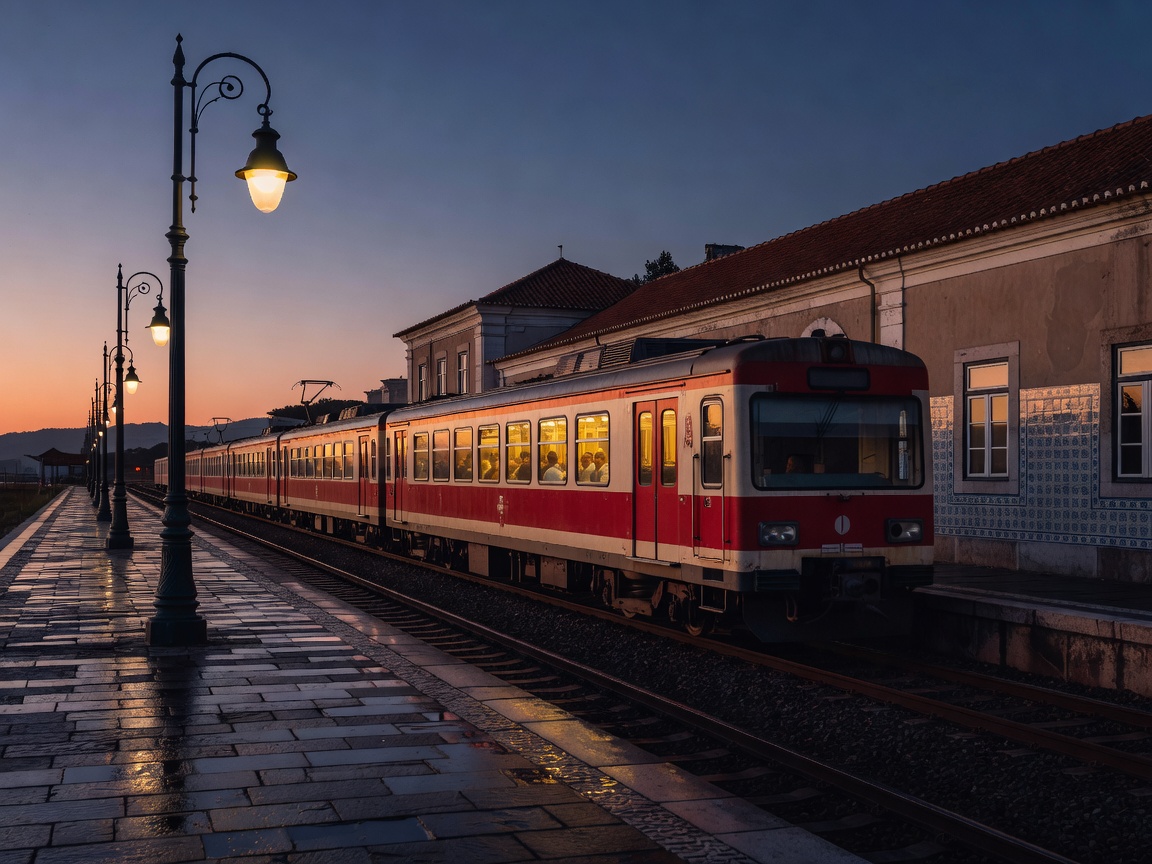
 5 days
Lisbon to Porto by train
Every departure time and fare we actually used, with the Douro line included.
Home / Transport
Trains that are cheaper than they should be, a toll system designed to confuse foreigners, and two transport cards worth understanding before you land.
If your trip is Lisbon, Porto, Sintra, Coimbra, Braga, Aveiro, Évora or Faro, take the train and do not hire a car. If your trip involves the Alentejo interior, the Costa Vicentina, inland Algarve or Madeira's mountains, hire a car and accept the tolls. Almost every itinerary we publish is built on that single rule.
Portugal's public transport is inexpensive by western European standards and generally punctual. The weak point is rural bus frequency: in the interior, two buses a day is normal and none on Sunday is common.
Comboios de Portugal (CP) runs four service tiers. The distinction matters mostly for price and reservation rules.
| Service | What it is | Reservation | Example fare |
|---|---|---|---|
| Alfa Pendular (AP) | Tilting express, Braga–Porto–Lisbon–Faro | Compulsory, seat assigned | Lisbon–Porto €31.90 (from €19.90 advance) |
| Intercidades (IC) | Intercity, 20–40 min slower, very comfortable | Compulsory | Lisbon–Porto €25.50 |
| Regional / InterRegional | Stops everywhere; the Douro line is one of these | None — buy and board | Porto–Pinhão €14.50 |
| Urbano (suburban) | Lisbon, Porto, Coimbra commuter networks | None — use a travel card | Lisbon–Sintra €2.45 |
Book at cp.pt or in the CP app. Tickets open roughly 60 days ahead and the cheapest promotional fares vanish first — buying two months out can halve the price of a Lisbon–Porto seat. Walk-up fares are never sold out on regional trains but often are on the AP in August.
Two practical notes: Porto has two stations, Campanhã (long distance) and São Bento (city centre and the Douro line), and the shuttle between them is included in your long-distance ticket. In Lisbon, long-distance trains use Santa Apolónia and Oriente, while Sintra and the west use Rossio and Cais do Sodré.
| City | Card | Cost | How it works |
|---|---|---|---|
| Lisbon | Viva Viagem / Navegante occasional | €0.50 card | Load "zapping" credit (€1.65 per journey) or a 24h pass at €7.10 (metro, bus, tram, funiculars) |
| Porto | Andante Azul | €0.60 card | Load zone-based titles; Z2 covers the centre at €1.60, airport is Z4 at €2.85 |
| Coimbra | SMTUC ticket | — | Buy on board €2.00 or in kiosks €1.10 |
| Faro / Algarve | Vamus | — | Regional bus network; single fares €2.35–5.60 |
One Viva Viagem card cannot hold two different products at once, and it cannot be shared between two people on the metro. Buy one each; they cost fifty cents.
Rede Expressos and FlixBus cover routes the railway misses — Óbidos, Nazaré, Monsaraz, much of the Alentejo — and are often cheaper than the train. Lisbon's long-distance terminal is Sete Rios; Porto's is Campo 24 de Agosto. Book online for the best price; luggage is included and the coaches are modern, air-conditioned and punctual.
Where the train and the bus both run, take the train. Where only the bus runs, it is usually perfectly civilised.

Rental costs €30–60 per day in summer and €18–30 off-season. You need a credit card in the driver's name, and an EU or international licence. Diesel and petrol hover around €1.68–1.78 per litre in 2026.
The complication is tolls. Several motorways — notably the A22 across the Algarve, the A25, A28 and A24 — have no toll booths at all. Cameras read your plate and the bill is issued later. For a foreign-registered or rental car this creates three options:
Costs €1.50–2.50 per day plus the tolls themselves. Simplest, and what we recommend for trips of a week or less.
At a border or airport kiosk, link your card to the plate for 30 days. Works well if you collect the car outside the country.
The old N-roads run parallel, are slower by 30–50% and are often more beautiful. Set your satnav to avoid tolls if you are not in a hurry.
Never simply ignore a toll: unpaid charges are passed to the rental company, which adds an administration fee of €25–35 per transaction.
Rarely. Portugal's point-to-point fares are low enough that an Interrail pass only pays off if Portugal is one leg of a much longer European trip. Book individual advance tickets instead.
Alfa Pendular and Intercidades services have accessible carriages, but you must request assistance through CP's Serviço Integrado de Mobilidade at least 48 hours before travel. Older regional stations often have no lift.
Technically yes, practically no. Tram 28 in Lisbon is crowded and the aisles are narrow. Use the metro or a taxi when moving between hotels.
Folding bikes travel free on all trains; full-size bikes are allowed on regional services and on the AP with a €6 supplement. The Ecovia do Litoral in the Algarve and the Ecopista do Dão are the two best long routes.
Yes on metro, suburban trains, trams and buses — tap your card on the reader at the gate or on board. Fines for travelling unvalidated start at €120.
Three guides where the timetable detail actually matters.
5 daysEvery departure time and fare we actually used, with the Douro line included.
 Day trips
 7 days